
RESEARCH NOTES / EMBODIED AI
Embodied RSI: Better Tasks, Better Improvers?
Research review · English / 中文The key to recursive self-improvement is not how many times a loop runs, but what the next iteration inherits—and what that inheritance achieves.
This review separates the task system from the process that improves it, examines four embodied AI papers, and uses Ai2’s evaluation study and AIDE²’s ignition test to assess the evidence.
THE CENTRAL DISTINCTION
Task gains, persistent updates and improved improvement capability are different evidence claims.
The embodied cases reviewed here mainly support L2. PhysEvo offers L3 structural evidence; controlled evidence of L3 gains remains a separate question.
1 · Concepts and evidence
Two functional roles
The task system, , performs tasks. It includes the model, tools, skills, memory and code. The improvement process, , diagnoses failures, proposes changes, searches over candidates and arranges validation. An improver implements that process; it need not be a separate model. One model can serve both roles. 1
Updating and retaining the task system is self-improvement in a broad sense. Recursion further concerns changes to the method that produces future improvements. A recursive structure does not by itself establish greater improvement capability.
What L1, L2 and L3 establish
| Level | Object of the claim | Evidence required |
|---|---|---|
| L1: task or artifact gain | A current answer, program artifact or execution result | A better result, without established persistent change to the task system |
| L2: persistent task-system update | Model weights, skills, memory or execution code | Changes are retained and used in subsequent execution; gains and transfer are reported separately |
| L3 structural evidence | The process producing future improvements | A modified diagnosis, search or update mechanism is inherited by later improvement rounds |
| L3 gain evidence | The effectiveness of the improvement process | From the same starting system, with comparable budgets and evaluation, the new process produces better successors |
These are the report’s operational distinctions. “Strong L2” describes substantial experimental support for retention and task gains; it is not another formal level. Persistence and generalization are separate properties. Limited transfer does not imply that no system update occurred.
Key terms
| Term | Meaning here |
|---|---|
| Agent | A complete system that observes, decides and acts; not just a model |
| Harness | The surrounding code and mechanisms organizing model calls, tools, context and task workflows |
| Skill | A reusable capability implemented by a program or a learned policy |
| Policy | A rule or model that selects actions from observations or states |
| Rollout | Executing a policy and recording actions, states and outcomes |
| Retention | Reusing an accepted change in later tasks or improvement rounds |
| Held-out evaluation | Evaluation on data or tasks excluded from the development and selection stage under discussion |
2 · Six mechanisms and a shared loop
Wu et al.’s survey organizes work by update mechanism. The six mechanisms describe what changes and how; L1/L2/L3 describe what the evidence establishes. Neither replaces the other. 1
| Mechanism | What changes |
|---|---|
| Weights | Model parameters updated through training |
| Tasks | What the next round practices, explores or collects |
| Memory | Experience stored and retrieved for later decisions |
| Programs | Tools, skills, prompts or workflow code |
| Feedback | Signals or mechanisms used to assess outcomes |
| Improver | The method for diagnosis, search and generating the next update |
01 · ExecuteProduce task experience
02 · DiagnoseLocate failures and weaknesses
03 · ModifyPropose candidate updates
04 · ValidateCheck gains, regressions and cost
05 · RetainReuse accepted changes
Software and robots share this loop. Robotics additionally incurs physical interaction, scene-reset, hardware-wear and human-intervention costs. Feedback mechanisms may improve, but final evaluation standards must remain protected: changing the scoring rule must not masquerade as better performance.
3 · Two update targets and a research workflow
Physical RSI is a convergence of mechanisms rather than one standardized algorithm. After observing and diagnosing failures, a system can repair its harness or skills, collect targeted experience, update policy weights, and validate and retain the result. These branches can be combined.
- Harness and skill updates: experience changes tools, code, memory and reusable skills; model weights may remain frozen. PhysEvo and RoboRSI are the central cases here.
- Model and policy updates: failures change the next training data, data changes the policy, and the new policy changes the failure distribution. EmbodiRSI is the central case.
- Automated research: describes who proposes solutions, runs experiments and selects results. ENPIRE can edit programs or organize policy training, overlapping both update targets. It is not a third parallel kind of object being updated.
4 · Four embodied papers
PhysEvo: updating execution tools and diagnostic resources
Mechanism: model weights stay frozen while execution feedback drives tool and skill changes. The Task Harness supports execution; the Meta Harness supports diagnosis and improvement. Tools used to diagnose future failures can themselves be rewritten and retained.
Retained: reusable execution capabilities and diagnostic resources.
Evidence: strong L2 + L3 structure. An independent comparison of old and new improvers, starting from the same task system under comparable total budgets, is still needed to isolate improvement capability. 2
RoboRSI: accumulating reusable skill repairs
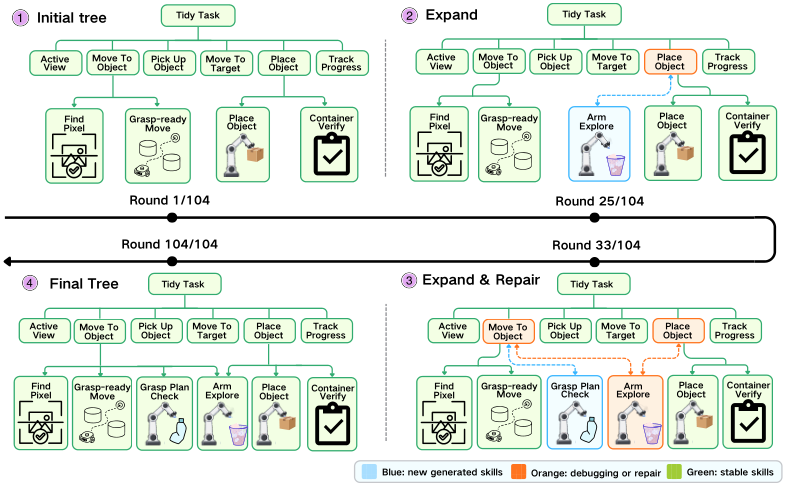
Organization: people provide goals, constraints and corrections; the system maintains a task–skill hierarchy. The Manager manages and reviews, the Planner plans, the Engineer implements and invokes skills, and the Reviewer checks and diagnoses. These are roles, not necessarily four separately trained models.
TSR—Top-Down Skill Refinement: locate the failed node → modify the responsible branch → check new tasks and existing capabilities → release a reusable version.
Retained: skill code, interfaces, checks and composite skills.
Evidence: strong L2. The paper reports 104 rounds of real-robot development, alongside simulation reuse and transfer experiments. It does not establish L3 gains. An additional ACT experiment—training a policy that predicts a chunk of actions—does not mean the main loop retrains a general model at every iteration. 3
EmbodiRSI: changing data, then changing the policy
Loop: execute the policy → identify failures → correct errors or collect targeted data → train a new policy → execute again.
Six modules: Real2Sim reconstructs simulation; Trajectory Generation creates trajectories; Policy Training & Rollout trains and executes; Collaborative Error Correction generates corrective trajectories; Adaptive Data Collection targets weaknesses; Sim2Real adapts the policy using limited real experience.
Training versus testing: during training, GPT-5.5 agents organize data and correction, planning tools generate trajectories, and training code updates the robot policy; real-world refinement includes human participation. Formal testing disables external takeovers, planner recovery and human correction, leaving the trained policy to execute independently.
Result: across 3 scenes and 14 subtasks, 400 simulation trajectories plus 10 real refinement trajectories per subtask yield 83.1% real-world scene-balanced success, versus 75.0% for a baseline using 200 real demonstrations. Scene-balanced scoring weights scenes equally. The retained real training trajectories are 1/20 of the baseline count; total cost is not thereby 1/20.
Evidence: strong L2. Data and policy weights persist. Policy improvement does not demonstrate that the data-collection or training method has itself improved; the coordinating language model is not trained by this loop. 4
ENPIRE: organizing real-robot research automatically
Organization: a research agent proposes solutions, edits code, runs real experiments and selects candidates using fixed evaluation feedback.
Updates: policy programs, training-algorithm code, trained weights and research experience. Reset, success-verification and safety interfaces remain fixed after environment construction.
Relationship to the other cases: both program editing and policy training can be research choices. Automated research describes the workflow, not a third update target alongside code and weights.
Evidence: L2 + indications of inherited improvement resources. Retained and transferred research experience deserves separate analysis, but automated experimentation alone cannot establish L3 gains. 5
5 · Comparing retained changes and evidence
| Work | Main retained changes | Assessment in this review |
|---|---|---|
| PhysEvo | Execution tools, skills and diagnostic resources | Strong L2 + L3 structure; improver gains require separate testing |
| RoboRSI | Skill code, interfaces and checks | Strong L2; task gains are not improver gains |
| EmbodiRSI | Datasets and policy weights | Strong L2; higher success does not establish self-upgrading collection or training methods |
| ENPIRE | Policy/training code, weights and research experience | L2 + inheritance indications; audit policies and research processes separately |
Comparisons should report update targets, retained changes, budgets, real versus simulated environments, held-out evaluation and limitations. Success rates from different environments, data budgets and metrics do not form a directly comparable leaderboard.
6 · A software comparison: AIDE²
For AIDE², this review defines the inner research agent as task system and the outer rewriting and selection process as . Improving the inner agent does not automatically improve the outer process.
The main experiment ran for 8 days, produced an evolutionary trace of 100 nodes, accepted 7 rewrites, and raised the private score from 0.703 to 0.778, with additional external benchmark evaluation. Because private scores inform candidate selection, they are not equivalent to a final test untouched during development. The paper separately introduces an ignition test asking whether the evolved agent is better at serving as the outer improver. 6
7 · Ai2: evolution gains or more search budget?
Ai2 is the Allen Institute for AI. Its evaluation paper compares parallel sampling, sequential revision, cross-task harness evolution and task-specific harness adaptation, with comparable feedback and inference budgets. 7
| Terminal-Bench setting | Parallel sampling | Harness evolution |
|---|---|---|
| No unit tests, mean pass@1 | 72.3% | 67.4% |
| With unit tests, mean pass@1 | 82.0% | 69.7% |
Terminal-Bench evaluates terminal-operation tasks. Pass@1 measures the passing performance of a single output, although the overall method can use feedback to select candidates. The experiments use three models, two independent runs, and sampling/iteration budget parameter .
The held-out experiment uses 45 training, 10 validation and 34 test tasks. Mean pass@1 across three models is 63.2% → 63.2%, showing no average improvement.
The conclusion is not that harness evolution never works. Version 4 also reports a positive case in long-horizon interactive games, emphasizing how tasks, feedback detail and budgets affect outcomes. Robotics should likewise account separately for model calls, interactions, resets, training and human intervention. This is the present review’s implication for robotics, not a robot experiment performed by Ai2.
8 · The ignition test: has the improver improved?
Fix the starting system, budget and evaluation
Let be the shared initial task system, the improvement process, and a comparable resource budget. is the accepted successor; the superscript denotes an updated version, not guaranteed improvement. is a quality score under a fixed evaluation protocol. averages over the specified task sampling and run randomness.
Here is the expected quality gain. Let and denote the new and old improvers, and let denote their gain difference, with “imp” short for “improver”:
Credible L3 gain evidence must support , with repeated runs and uncertainty estimates. This is explanatory notation introduced by this review, not AIDE²’s original scoring formula. Counts, time and monetary costs should be matched separately rather than added across incompatible units.
What AIDE² actually compared
Both groups begin from the same inner agent, AIDE₄₇. One uses the evolved AIDE₄₇ as the outer improver; the other uses the human-engineered AIDE_human. The latter is an agent system, not a person performing the experiments live. Each group uses 3 random seeds and 50 steps per seed. 6
Reference improver
AIDE_human
0.782Mean endpoint score
Evolved improver
AIDE₄₇
0.780Mean endpoint score
The authors’ conclusion is inconclusive. Signs that the evolved improver reaches near-final quality earlier do not establish a reliable advantage with only three seeds. An ignition test asks which process is better at generating the next improvement; it does not require AI to outperform humans.
9 · Returning to the survey’s questions
- What changed? The current artifact, the task system, or the process producing modifications.
- What was retained? Whether updates participate in later tasks or improvement rounds.
- What was demonstrated? Task gains, transferable gains and improver gains each require evidence.
The cited embodied cases demonstrate persistent system updates; PhysEvo additionally provides structural evidence concerning the improvement process. Higher robot success alone does not show that the improver is better. This conclusion concerns the versions and experiments reviewed here, not a claim that such evidence cannot exist anywhere in embodied AI.
References and the original report
- Hao Wu et al. Recursive Self-Improvement in AI: A Survey. 2026. Preprint.
- Wenqing Tian et al. PhysEvo: Astra Can Act, Let It. 2026.
- Zimo Wen et al. RoboRSI: Stable, efficient, and reusable robot self-evolution in complex real-world environments. 2026.
- Haoran Lang et al. EmbodiRSI: Recursive Self-Improvement for Data-Efficient Robot Adaptation. 2026. §4.3 and appendices.
- Wenli Xiao et al. ENPIRE: Agentic Robot Policy Self-Improvement in the Real World. 2026.
- Dhruv Srikanth et al. AIDE²: Recursive self-improvement of AI research agents. 2026. Ignition test: §3.6.
- Yike Wang et al. Rethinking the Evaluation of Harness Evolution for Agents. 2026. v4; §4, Tables 1–3; §5.
This is the blog reading edition of the review. Full comparison tables, supplementary papers, original figures and historical notes remain in the Feishu research report, subject to its existing access permissions. This article is self-contained. The website and Feishu report are maintained separately; later Feishu edits do not automatically update this page.
Sources reviewed through 23 October 2026; web edition prepared 27 October 2026. Evidence labels are this review’s synthesis. Paper results and the review’s implications are distinguished above.