
HCI OBSERVATORY / INDEPENDENT STUDY
Claude: when chat starts taking action
Source review and interface reading · revision 2 · draftAs an AI interface begins operating tools, the human’s role expands from reading an answer to supervising a task. This study asks whether the user’s intention, the agent’s activity and the working source remain understandable together.
Version boundary. The image was retrieved from the current Cowork product page. Its filename references the August browser launch, but that is not a verified client version or capture date. The demonstration uses fictional supplier content. It is evidence of a displayed interaction pattern, not live pricing or a confirmed latest-build capture. Official product page, dated browser announcement.
A task worth evaluating
Ask an assistant to compare two supplier websites and prepare a source-grounded summary. Success requires selecting the right suppliers, keeping track of the relevant pages, distinguishing retrieved facts from inference, and allowing the user to inspect the final comparison before any consequential follow-up.
The path to study is: clarify the request → identify the source → observe browser work → inspect the summary → correct or stop the task. No completion time or success rate has yet been measured.
Reading the interface
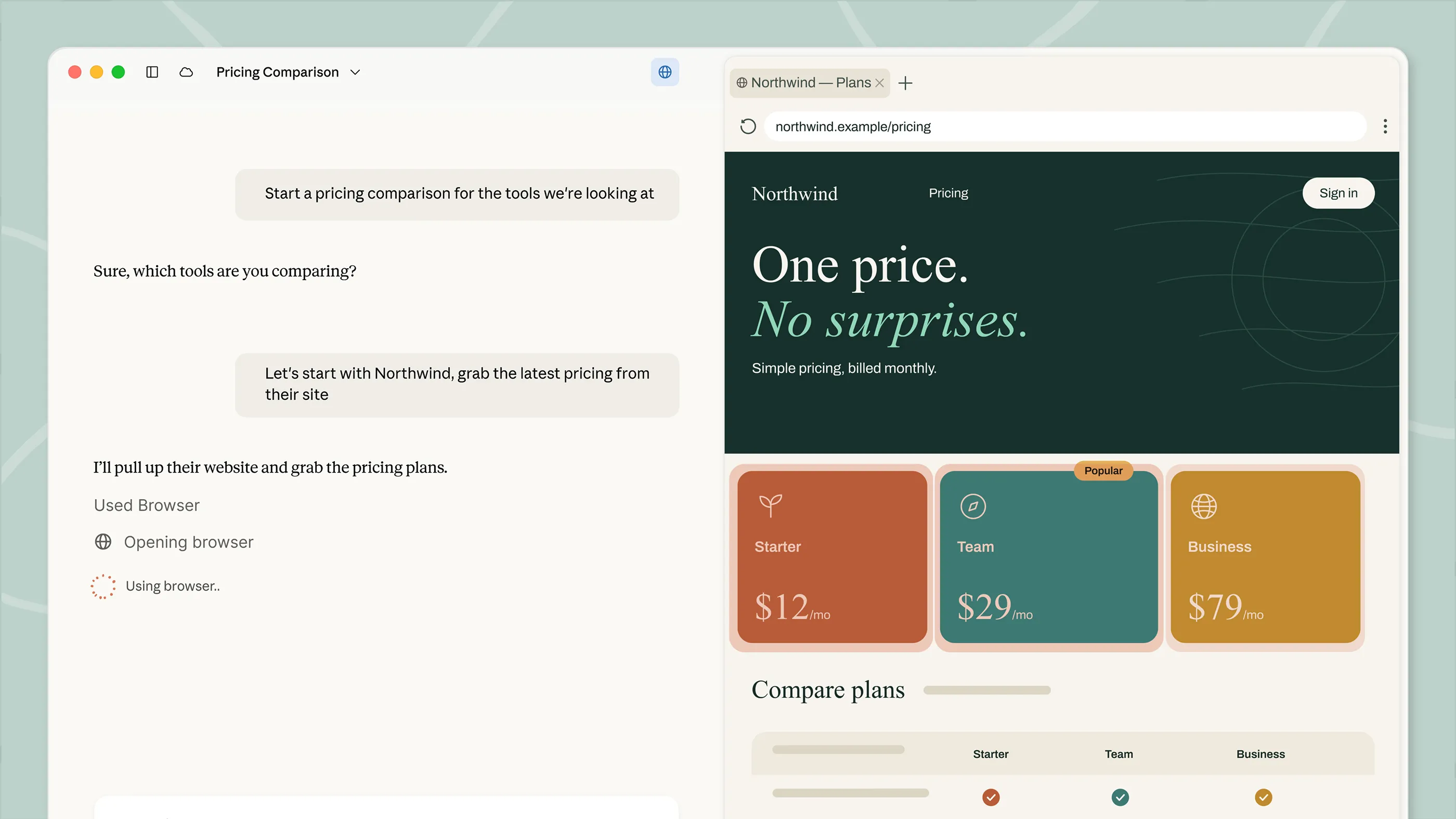
- Intent remains on screen. The left conversation includes a clarification and a specific supplier request.
- A visible working source. The adjacent browser exposes the page, tab and address. A user can connect a claim with what the assistant is looking at.
- Tool activity feedback. The conversation reports browser use and shows ongoing activity. That says something is happening, not that the comparison is complete.
What other researchers and authors add
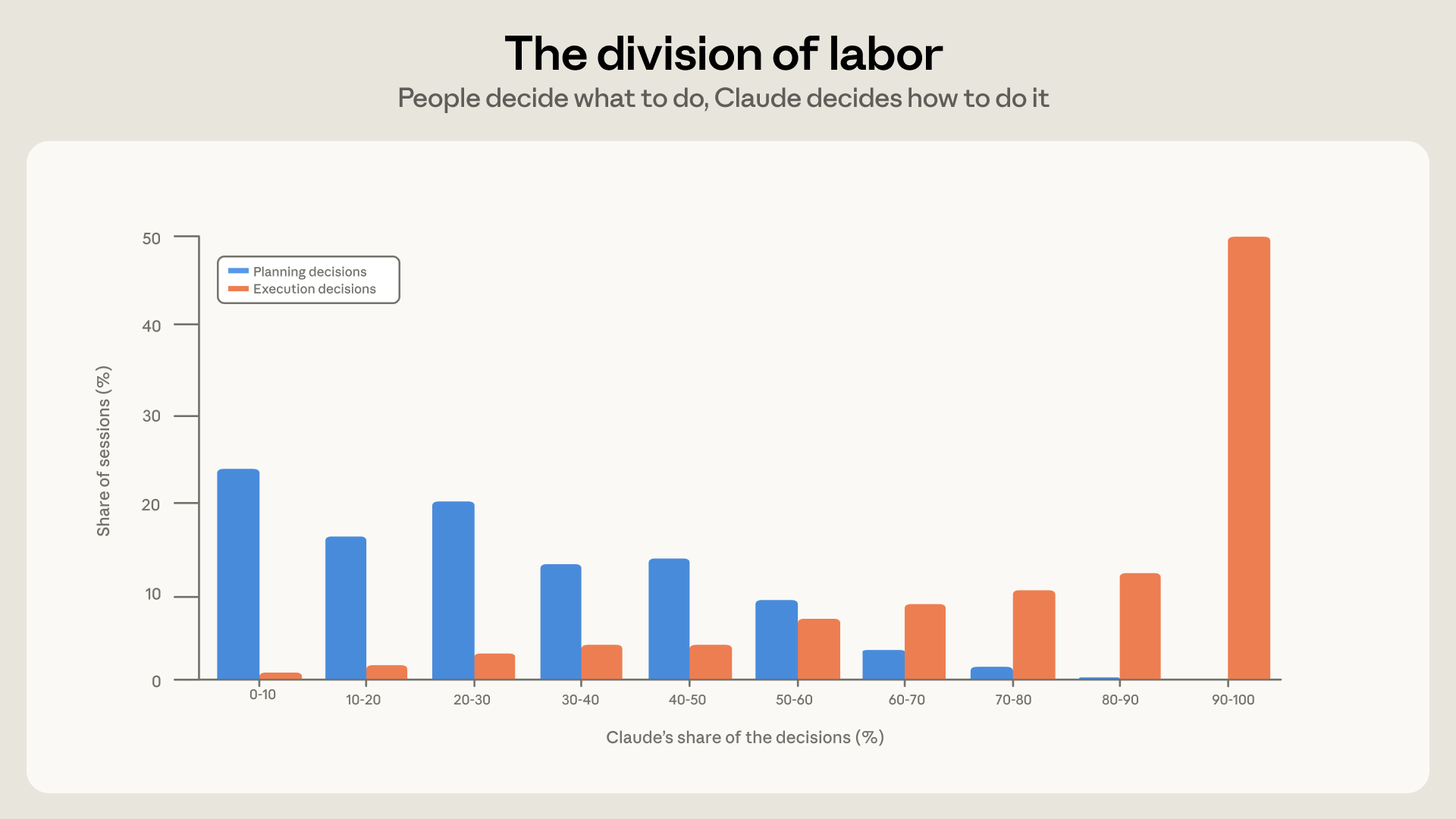
Vendor research Anthropic’s Claude Code report uses logs to study planning and execution. It suggests asking who sets the goal and chooses the actions, but is not a Cowork usability test. Report and methods.
Authors’ account Valliance’s Claude Design account follows a task through iterations, direct feedback and mixed information. Original account. It concerns an April browser interface, not Cowork.
Our follow-up: does delegated work preserve intent and connect activity with evidence? Source review can motivate the question; the particular interface still needs appropriate evaluation. Five illustrated readings.
What works well
Interpretation The side-by-side layout supports recognition: the user can consult the request and the working page without holding both in memory. It also gives inspection a concrete target. Rather than relying entirely on a confident summary, a person has a source page to compare against it.
The visible clarification makes an underspecified request part of the interaction. Asking which tools to compare can prevent the assistant from pursuing the wrong comparison. In this demonstration, the conversation acts as both task description and a record of how the task became more specific.
The browser announcement describes a browser inside the desktop app, separate from a person’s usual browser, alongside the existing Chrome integration. That distinction is useful for explaining delegation, but it also creates a concept the interface must teach. Browser announcement.
Where the interaction may become difficult
The meaning of delegation. A person who is used to asking for advice may not expect a similar-looking conversation to operate tools. The interface should explain the current scope in terms the person understands: which source, which account, what may be read, and what may be changed. This screenshot does not reveal the entire permission flow, so it cannot establish whether that flow is absent or adequate.
Browser identity. A visible address helps identify a website, but not necessarily the account or browser environment in use. My hypothesis is that users may confuse the built-in browser with their normal browser when correcting a task. A walkthrough should test this rather than assume confusion.
Activity versus evidence. Ongoing activity is useful feedback. For a comparison, however, the user also needs to know which suppliers were visited, which facts were extracted, and which sources remain unchecked. A spinner should not be mistaken for evidence of accuracy or a promise about time remaining.
The cost of supervising. Current safety documentation distinguishes read and write tools, describes cloud sessions reaching connected local resources through the desktop app, and explains approval modes and deletion protection. These are documented rules as read on 3 October, not behavior verified from this promotional image. The HCI question is whether the user understands the rules at the moment of action. Current Cowork safety guidance.
The critique uses status visibility, recognition, error prevention and user control from Nielsen’s heuristics. It makes no claim about measured cognitive load or accessibility compliance.
A concrete redesign to explore
Try a persistent delegation summary between chat and browser. It would identify the working browser and source, expose task milestones, and distinguish gathering information from taking an external action. Put a review checkpoint where the task’s consequences increase, while allowing routine reading to continue.
PROPOSED INTERFACE / ILLUSTRATIVE CONTENT, NOT A PRODUCT SCREENSHOT
Compare two supplier plans
Clarify suppliersGather sourcesReview comparison
Working surface: Cowork built-in browser
Current scope: read selected public pricing pages
Before external action: review the intended destination and effect
Inspect source pagesCorrect the taskStop further actions
The stop label would explain whether an already completed change remains in place. Any recovery action must identify its supported scope; stopping future browser work cannot promise to undo every earlier action.
How the judgement could be tested
Prepare two fictional supplier pages with a deliberate mismatch between a headline price and a relevant detail. Test whether novice and experienced participants notice the mismatch and can point to the source behind their final choice. Use identical content for each interface variant and counterbalance task order.
Ask participants to identify the working browser and scope, correct one supplier choice, and stop a prepared task before an external action. Record task success, wrong turns, requests for help and time in seconds. Afterwards, ask them to explain what stopping did. A visually calmer screen would not be an improvement if it made the working boundary harder to understand.
Current conclusion: the demonstrated combination of conversation, source page and activity feedback supports inspection. The next design question is whether that same flow communicates the scope and consequences of delegated work clearly enough.
Research record
-
Revision 1 · 3 October 2026: dated feature context, official demonstration, documentation checks and heuristic critique added.
-
Revision 2 · 3 October 2026: session-research figure, designers’ account and illustrated readings added, with Code/Design/Cowork scope stated.
-
Next: capture a specified desktop build’s clarification, permission, running, result and recovery states. Study ordinary Chat and Artifacts separately before comparing them with Cowork.
This draft uses AI assistance and awaits my personal review. It does not claim personal product testing. Study method · Codex study.