
HCI OBSERVATORY / INDEPENDENT STUDY
How others study AI interaction: five illustrated readings
Literature and experience review · revision 1 · draftAn observation series can begin by reading other people’s work. These five primary sources show what was studied, how the argument is written, what the original illustration shows, and what we can learn from it.
This is a short source review with editorial interpretation. Participants, logs and firsthand experiences belong to the original authors. Different products and dates cannot establish a ranking of today’s Codex and Cowork.
01 · A Codex walkthrough: follow one task
Author and source: Janine Heinrichs, Unite.AI, 28 May 2026. OpenAI Codex Review.
The author documents a landing-page task through project setup, planning, execution and inspection, with screenshots along the way. This is a personal account, and the publisher discloses affiliate links. It is not a controlled user study.
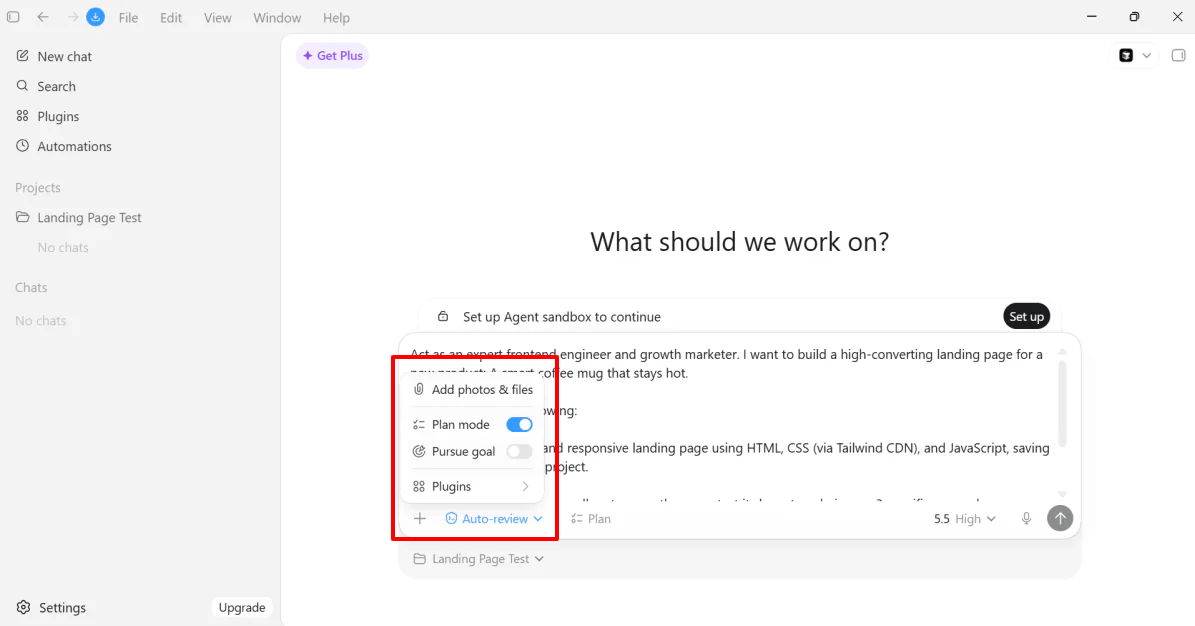
Writing pattern: task → steps → state screenshots → experience. We could add checks for finding the right project and result. A menu image does not verify permission behaviour; the reported speed cannot establish general performance.
02 · Grounded Copilot: build an explanation from behaviour
Authors and source: Shraddha Barke, Michael B. James and Nadia Polikarpova, OOPSLA 2023. Author-hosted paper · DOI.
The study observed 20 participants and identified acceleration and exploration: using AI to complete a known next step or to discover a direction. Its subject was GitHub Copilot of that period.
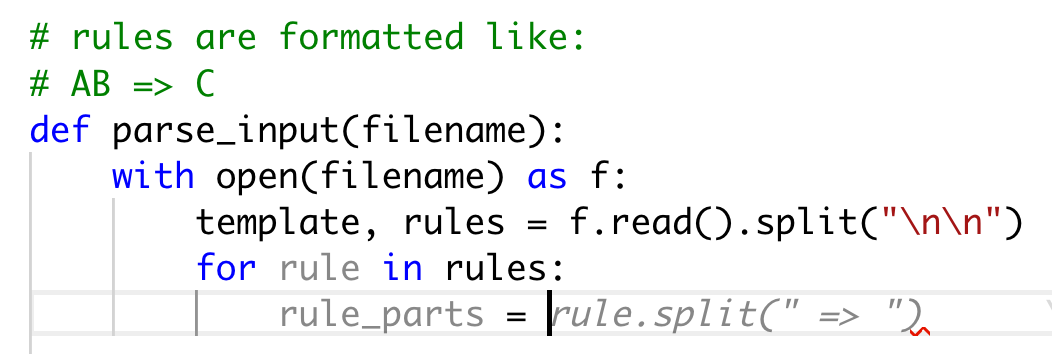
Writing pattern: observation method → recurring behaviours → explanation → design implications. A question for Codex is whether known and exploratory tasks need different planning support. That transfer requires testing; the paper did not evaluate today’s desktop app.
03 · RECAP: reconnect conversation and code changes
Authors and source: Keyu He, Qianou Ma, Valerie Chen, Wayne Chi and Tongshuang Wu, arXiv v1, 1 May 2026. Paper and figures.
RECAP links chat and code records. Its university deployment collected records from 41 students, including chat data from 29. The system targets VS Code and Copilot. This preprint’s system demonstration is not a Codex-versus-Claude experiment.
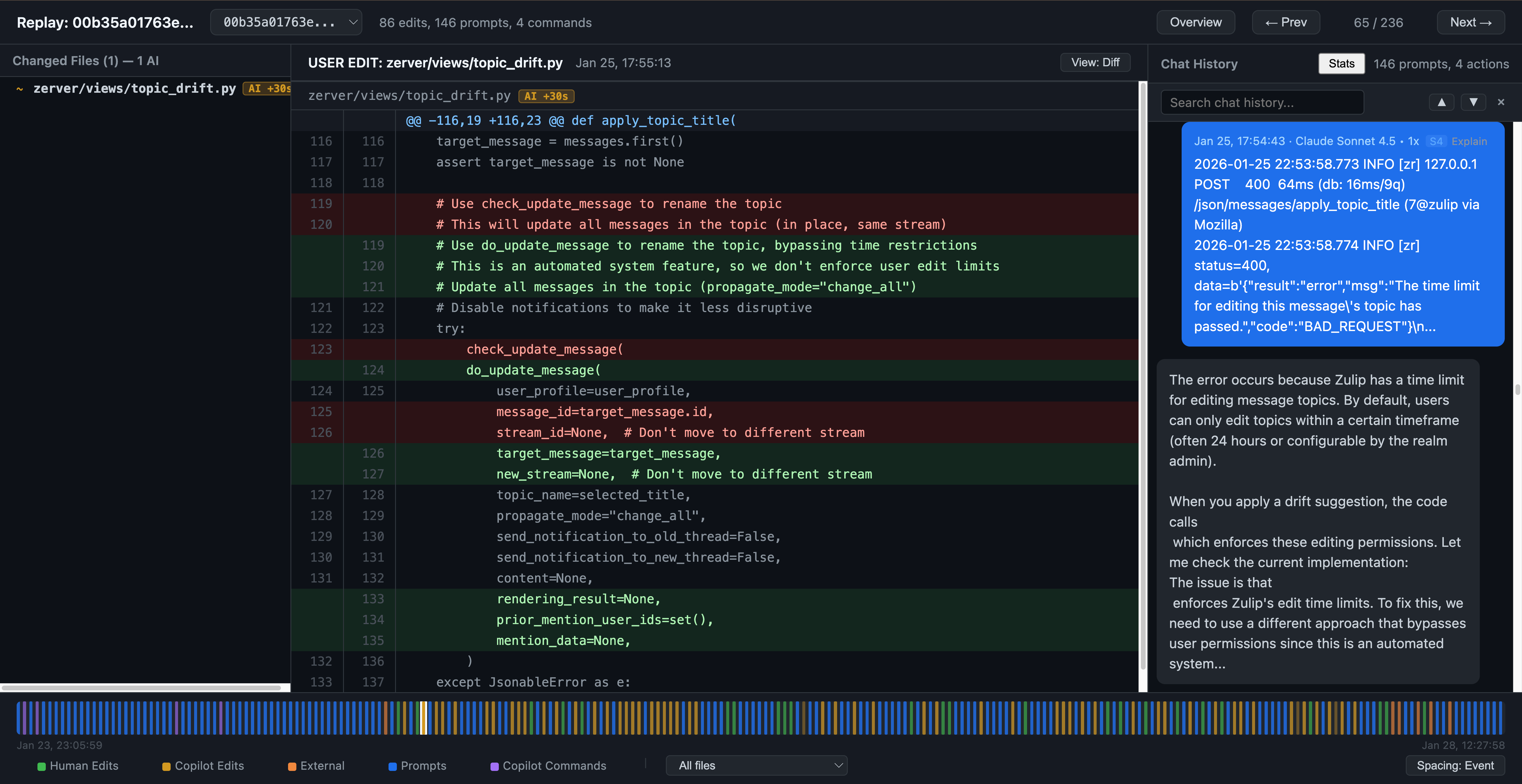
Writing pattern: research question → recording system → linked evidence. Our own task records could connect requests, edits and checks, rather than keeping only the final successful page.
04 · Claude Code logs: define the measures before reading the chart
Source: Anthropic research team, Agentic coding and persistent returns to expertise, 16 June 2026. Original report.
The report analyses approximately 400,000 Claude Code sessions across CLI, web and desktop channels. People typically determine goals while Claude determines execution. These are classifier-derived transcript findings, not a Cowork button-usability experiment.
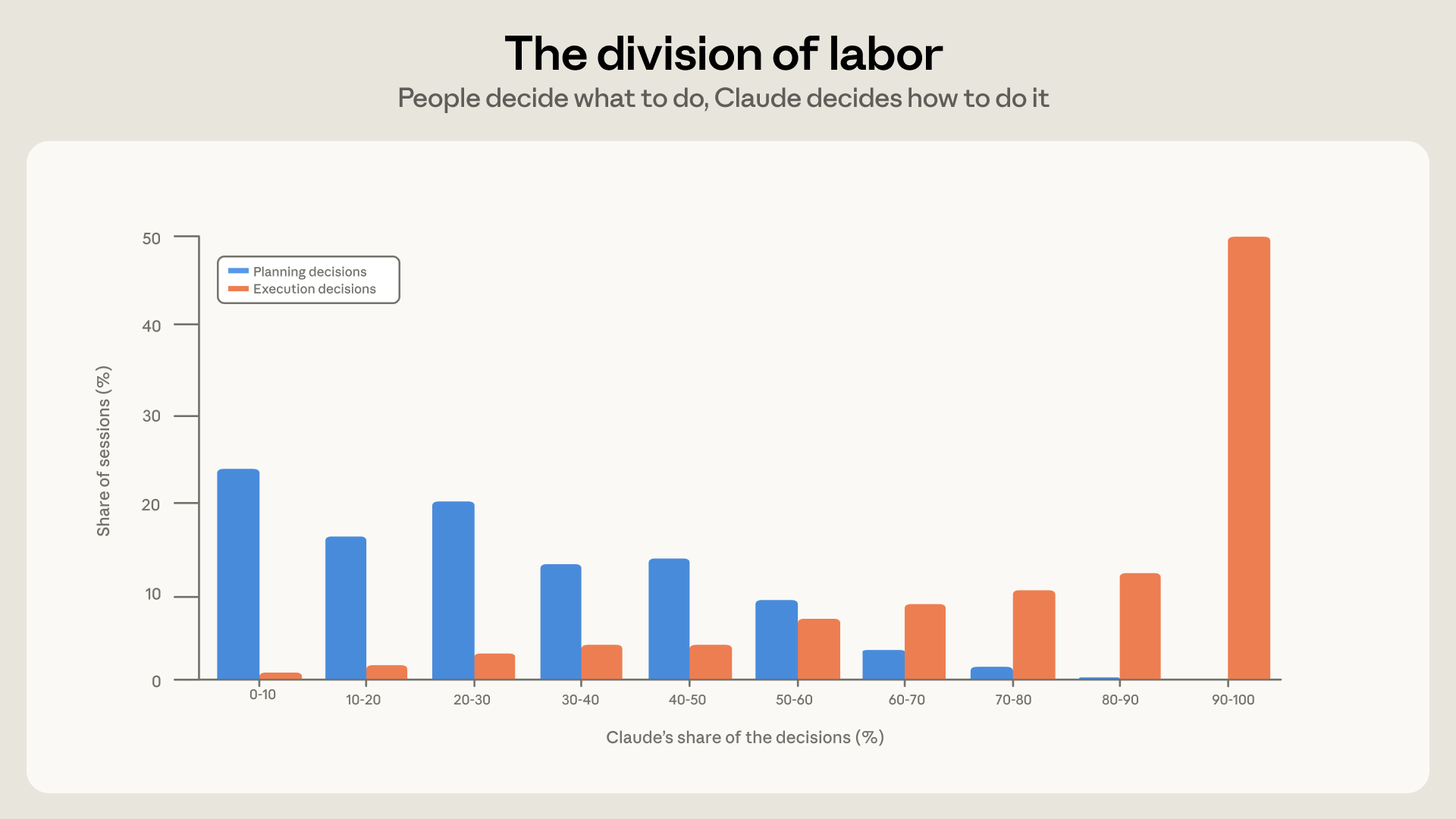
Writing pattern: sample → measure definitions → chart → limitations. For Cowork, we can ask whether delegation preserves the person’s goal and review points. Vendor data can inform that question, but cannot establish that a particular layout is better.
05 · A design team’s account: include the process and difficulties
Authors and source: Tom Moran and Dan Bradshaw, Valliance, 21 April 2026. Claude Design collaborative test drive.
Two designers explored a resource-library interface for about 90 minutes each. They describe different starting approaches, iterations and friction, praising direct visual feedback while questioning mixed chat information. This is a team case involving browser-based Claude Design.
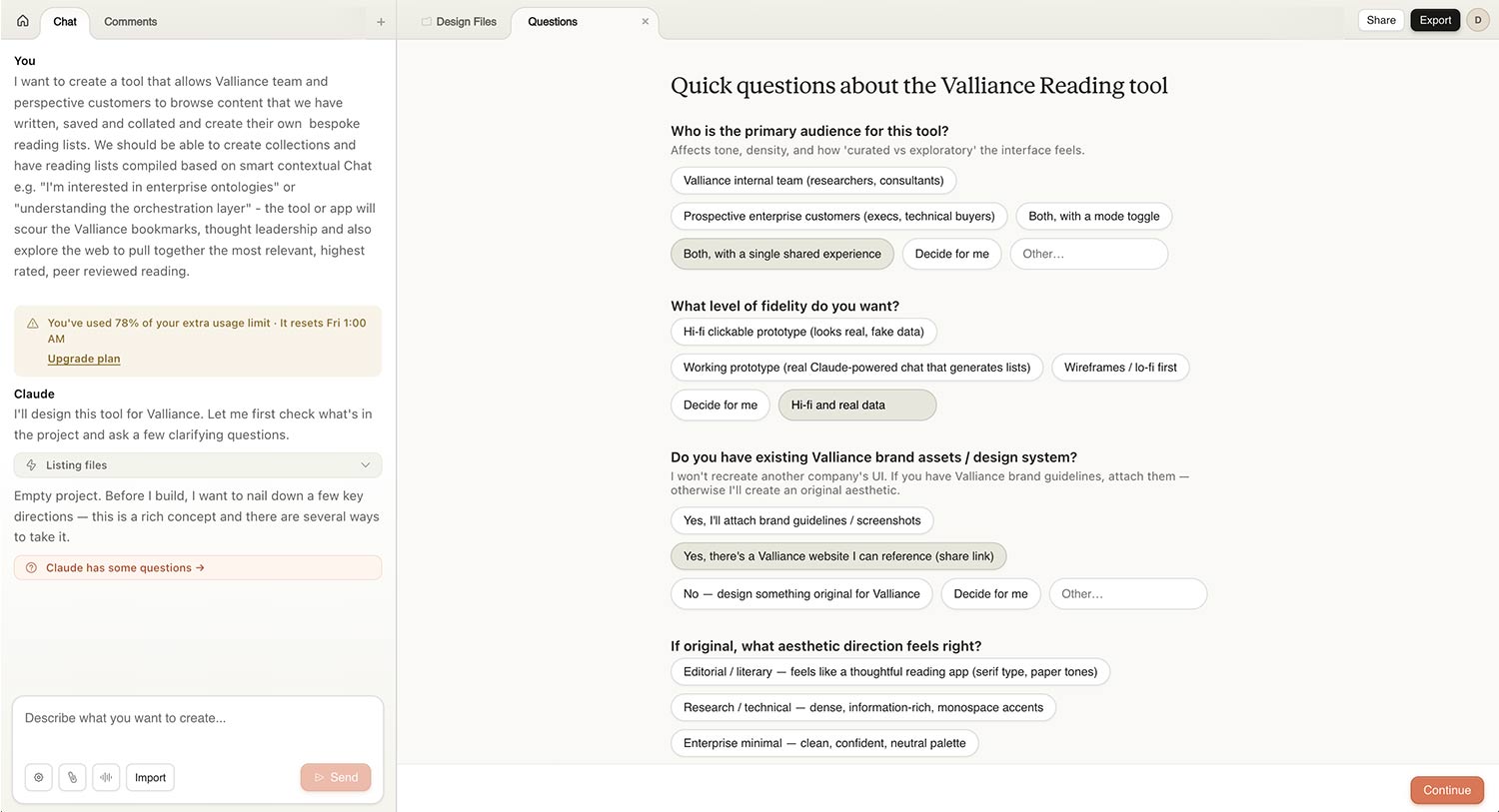
Writing pattern: shared task → different approaches → concrete friction → improvement. We can adopt that structure for feedback and recovery notes. Two authors cannot represent every user, and an April interface cannot establish today’s latest design.
A writing template for this series
A source review can follow question → author and method → illustration → brief finding → scope → our follow-up question. Add our own participants, task, platform and results only when an actual study happens.
- Source review: read and explain existing work; a new experiment is not a prerequisite.
- Interface reading: explain a sourced screen, separating facts from judgement.
- Firsthand observation: document our actual task and screenshots.
All three belong in the Observatory. Papers, vendor reports and personal accounts have different uses; inspect how evidence was obtained before extending a conclusion.
Sources and revision
This page includes limited illustrated excerpts and short summaries; follow each author link for the full text. The research image register links every image to its origin. Both papers carry CC BY 4.0; other images retain their owners’ credits. Retrieved 3 October 2026. The theme licence does not cover these third-party materials.
Revision 1 · 3 October 2026: five primary sources checked, five examples included, with writing patterns and scope. AI-assisted draft awaiting personal review.
Codex source review and interface reading → · Claude source review and interface reading → · Method →